Of Priceless Souvenirs and Cherished Memories

We spoke different languages, met by an element of chance; yet, his instant endearing act of hospitality will always be my most cherished memory. Where the Caspian Sea, the Black Sea and the Mediterranean share common ground, Turkey is the land I owe this priceless souvenir to.


It was just my second day on a backpacking trip to Turkey.

After a month of plans, research and bookings, we finally set off for a Western Loop of Turkey; picking up and hot air ballooning across western Cappadocia, scuba diving through southern Fathiye, lounging at Greek influenced Selçuk and dropping off at mesmerising Istanbul.

Our route was to take us from Mumbai to Istanbul, a change of flights onwards to Cappadocia. We touched down at Gülşehir at midnight and drove down to Göreme via Nevşehir.


Waking up at dawn at one of Cappadocia’s beautiful Cave Hotels, I stepped out onto the fresh cold stone floor. The sight that awaited me was pure magic – beyond the peaks of fairy chimneys, the soft rays of the early morning sun formed a silhouette around a magnificent hot air balloon rising up into the deep blue sky.


It was a novelty to actually step into one and get my first ride, though the experience of watching a multitude of them soar up above was exhilarating. To top it all, they give you a certificate to just stand in, enjoy a glass of champaign and enjoy cruising through the sky with a breath taking view below.


Cappadocia has an enchanting mystery to her, an eclectic blend of the old world Arabic charm and bohemian gypsy culture. It is a hub for backpackers and luxury travellers alike with places to explore and cuisines to sample that fit all budgets.

In the evening, it’s almost as if King Midas himself touched all the tops of the fairy chimneys giving Göreme a golden glow.

The journey by road from here on to Fathiye is long but breathtaking as you are travelling across high hills and valleys that finally open up to the sea. Make sure to be awake in the last lap of the journey as you see a gradual change in landscape from tall conifers to shrubbery and then on to cruising along a deep turquoise sea.


I was looking forward to Fathiye for my first ever independent scuba diving experience. After having secured my Open Water Dive certificate in Maldives, this was my first attempt without the watchful eye of my dive instructor back home.

From there, we drove up to Selçuk to experience a deep Greek influence. Ephesus consumed us with history and took us back to the beauty of yore but it was the small cottages in the hills of Şirince that will always stay back in my imagination.

After drifting through the history of the land we were now cruising through modern Istanbul. It is a bridge between the ancient multi-dynasties and Atatürk’s contemporary Turkey.


My favourite things to do in Istanbul: Arabic Music, Mevlana Dervish dance, fish sandwich, the Grand Bazaar, short cruises along the Golden Horn, meandering around the Blue Mosque, Dolmabahce Palace and most important of all – dream about Cappadocia!


And the food you say? From a simple traditional Turkish breakfast of boiled brown eggs, freshly baked bread with raw tomatoes, cucumbers and fresh garden berry jams to famous İstanbullu fresh fish sandwiches from bobbing bright boats at the Eminönü docks, döner kebaps, tavuk doners, an assortment of meat and eggplant preparations to the honey soaked baklavas and snowy turkish delights; my taste buds were on a roll!

Just imagine passing by a crisp, modern eight lane expressway squeezed in between an old world solid city wall extending to infinity. Yup, that’s just it. My last memory in the city sums up the overall image of Turkey that will be set in my imagination for a long time.


To say that I covered the highlights of Turkey’s 780,000sq km in a mere nine day sojourn is to clearly state the impossible. But seeing as I have truly fallen head over heels with the land’s charms, this was merely the beginning of an enchanting saga.


But I must end by saying that this trip would be just a trip without the souvenirs and memories I received from the people I befriended. I thank Jamal for making our stay memorable at the wonderful Dervish Cave Hotel in Göreme and Mustafa Mizrak for the endearing fatherly affection; the coffee Table Book and poster he gifted me are priceless and John for making my apprehensive moments while diving at Fathiye a sweet reminiscence.

Text and Image courtesy Diipti Jhangiani
Diipti is a writer and photographer. She can be contacted on http://diiptijhangiani.blogspot.com 

Limited Edition Pashmina Shawl


Pashmina Shawls  at Prrem's

Made from the finest yarn of Pashmina wool, treat your senses to this lush stole made from fine pashmina. Pure to its origin, Pashmina is one of the warmest, finest, softest varieties in wool. Pashmina is known to be at its best and highest in quality when made in its natural colours of creams and beige.
The term pashmina is derived from the word pashm - the local word for fine dehaired wool combed from the undercoat fibers of the Pashmina goat found in Ladakh in Kashmir.
What’s the difference between Cashmere and Pashmina you ask? Here’s what we found out.
The western culture identified this fine variety of wool by the geographic location in which these goats are seen i.e the region of Kashmir in North India. Thus the pashmina, fine wool from Kashmir came to being known as Cashmere.


Road Trip to Heaven and Back

Road trip through Bhutan with my 500cc Bullet
A 500cc Bullet and three days off from work. That’s all I needed to kick start my solo ride through Bhutan. Cruising though the lush green country side, this is about my solo ride all the way from Gangtok through Sikkim to the land of the Thunder Dragon, Bhutan.    
Bhutan is a very beautiful country, relatively undisturbed by outside influences. Almost no deforestation takes place. The mountains and forests are sacred and the common man is not permitted to explore.
My Journey
Day 1 took me from Gangtok to Pheuntsholing, the border town of Bhutan and its commercial hub. It lay right next to Jaigaon, the Indian border town. This route was fairly uneventful, except for some short bursts of rain. The highway passed through numerous tea gardens of north Bengal and Chapramari and Mahananda wildlife sanctuaries. Most of this route was in the plains of north Bengal, passing through towns with exotic names like Bagrakote, Oodlabari, Binnaguri, Mal, Hashimara, Nagarkata, Birpara, Madarihat etc. Finally, after a drive of about 8 hours, I reached Pheuntsholing.
Trashichoe dzong, Thimphu
Day 2
After an overnight stay, I proceeded towards Thimphu after collecting permits for myself and my bike. This was entirely a hill ride. Luckily, the journey was devoid of much rain, as was most of my Bhutan trip. One thing outstanding about the Bhutan trip were the roads. They have been built by India’s Border Roads Organisation (BRO) and for most part are impeccable. The 50 km stretch before Thimphu is the best example of a hill road I have ever seen. It’s a wide two lane highway where one can speed up to 60-90 kmph. The ride is along the river Wang Chu and is simply breathtaking for those willing to go slow.
Thimphu is a well laid out town, neat and clean with sparse population for a capital city. Civic infrastructure is comparable to any western country with an architecture that is entirely Buddhist. Locals  seem happy and content, they are quite warm and helpful, even the policemen. The National dress is mandatory for locals, though I did see many people  in western clothes. I rode on from the beautifully located land of Thimpu onward to Dochula Pass .[P1] Dochula is at 10,000 ft and was under an envelope of clouds when I arrived there. The 108 chortens there looked ghostly but enchanting. The surrounding snowy peaks were not visible. I spent some time there and then drove back to Thimphu before nightfall. The Dochula Resort is highly recommended for stay.
Day 3
The next day’s destination was Paro, the airport town of Bhutan. Paro is located in a picturesque valley that is relatively flat, along the river Paro Chu. It is surrounded by paddy fields. The town is small and unremarkable. The airstrip is small, but the surroundings are awesome. The must-do in Paro is the trek to Tiger’s nest monastery (Taktsang monastery). It is located on the edge of a cliff that is absolutely vertical and seemingly un climbable. The route is not so bad, but steep nonetheless. The conquest feels great and the view from the monastery is breathtaking. Thereafter, I drove around aimlessly among the beautiful alpine landscape and retired for the night.

Tiger's nest monastary
Day 4
I had a choice between riding back to Gangtok, which was achievable in a day or going round about via a pretty little town called Haa onwards towards Pheuntsholing, thereby losing 6 hours. I know what I should have done but the adventure bug had bitten me and in a moment of madness, I chose to ride towards Haa. So there I was, driving through the plains of north Bengal in the dark. The road was patchy and slowed me considerably. I did not think that time was a constraint. Even a late night arrival in Gangtok was not an issue. But then the inevitable happened.
It started as a drizzle and gradually intensified into a downpour. I had my rain gear on, and the luggage was well protected. I drove on through pitch darkness, and a deserted highway that did not seem to lead anywhere. To make things worse, I was passing through wildlife sanctuaries and tea estates at 10 pm. I then decided to drive towards Siliguri, a diversion of about 50 km, but my only hope. So I drove on through the downpour. I finally reached Siliguri at midnight. But my ordeal did not end there. All hotels had closed for the night. Finally, I checked into a hotel after one hour, thanked my lucky stars and retired for the night.
Opportunities for adventure sports and recreation in Bhutan are very limited and one would be better advised to explore India and Nepal for that purpose. Hotels and fuel in Bhutan are relatively cheap, but the food is terribly expensive. The best time to visit I’d say is between October and March, though there is a romance about off season solitude. 
All in all, for me Bhutan has wonderful landscape to offer and that in my opinion is best experienced while driving. So when in Bhutan, drive.  
(Image and Text Courtesy Abhijeet Bhatia)
Abhijeet Bhatia can be contacted on abhijeetbhatia77@gmail.com
www.imprintsonice.blogspot.com


Featuring this Month..

We bring to you every week,
a little story a little song,
we hope you too sing along,
wishing you warm travels from
Prrem's -Your Friendly Store


What to Wear in Winter

If you are a new bee frequent flier, are travelling to Canada when its at its chilliest or are just here for a good winter read, this is for you.
In Mumbai, as soon as the AC beeps 25°C, I need my hoodie by my side. So imagine my preparations for a trip to Ladakh! All my research brought me down to 4 basic layers essential for a cozy winter vacation. At the end of it all, I'd look like snow man! or so I thought..
A little from my research:
Base Layer: Thermals, also called warmers are the first and an extremely thin layer in touch with your skin. There are mainly two types: the woollen and polyester fabric. Wool thermals are best used for temperatures ranging from 8° C to upto -20°C. That's really really warm! The polyester fabric is useful for a minimum temperature of 8-9°C. Thermals are essential whether you are going for a trek in the mountains or are studying in Boston. Both woollen and polyester are available in sleeveless, half sleeve and full length sleeves and the bottom - also called long johns are also available in both materials. 


Mid layer: There is a lot of variety available in the mid layer: from merino wool sweaters, fleece hoodies, to polyester zippers. The most warm option of them all is a pure merino wool sweater.You can't go wrong with that. Know more about the qualities of wool

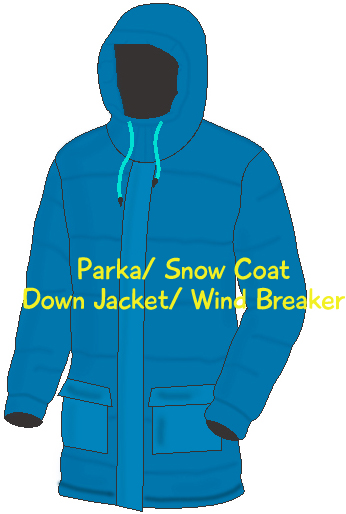
Shell Layer: That's your last layer. It must be snow, rain and wind proof so as to protect you from the elements. If your mid layers are warm enough, you need a single layer wind and water proof jacket. They are mainly available in the nylon/teslon/polyester variety. 
Make sure they have the seam lock mechanism, where in the seams are locked with a secure tape so as not to leak moisture. if you are venturing in the sub zero terrain, with temperatures reaching -30°C and below, you need a two layered shell jacket. The inner layer with a thick fleece or synthetic fur lining that keeps you warm and prevents your body heat from escaping out and an outer wind and water proof layer to protect you from the elements.


Accessories that are a must: woollen gloves, waterproof gloves for snow or rain, scarf, or muffler, woollen socks and a woollen cap to cover your head and ears, if in minus temperatures, a ski cap or monkey cap protects you better since you can cover your forhead, nose and mouth too, in case of a storm. 


So that's the basic layers I know I'll need. Hope it helps you.. 


Merino Wool and its Qualities

Wool is one of the world’s most versatile fibres, Merino wool being its most valuable contender. It is 100% natural and in our environmentally conscious times, its sustainability and biodegradability are a plus. Yet, these are but a few qualities to its credit. Read on to know more.

BREATHABILITY
In extreme exertion, you need a garment that 'breathes', which means it must be able to absorb perspiration and release it into the air. No fabric does that quite like Merino. The hydrophilic core of the Merino Wool fiber has an amazing capacity to absorb liquid - up to 35% of its own weight - so it's better than synthetics at removing sweat from the skin, moving it away, and releasing it as vapor.

MULTI-CLIMATE
While synthetics are passive, Merino Wool is active, reacting to changes in ones body temperature to keep you warm when you're cold but releasing heat and moisture when you're hot.

ELASTICITY
The natural elasticity of the Merino Wool fiber means they stretch with the wearer, but then return to their natural shape so there is less chance of garments sagging or losing their shape.

HEALTH
Merino Wool has a number of health benefits including improved sleep and lower incidence of microbial infection for hospital patients.

ODOR
Studies show that the wool fiber’s ability to absorb and neutralize unpleasant odors is far superior to that of other textiles. Through its chemical composition wool can neutralize bodily substances which give rise to unpleasant odors, a considerable advantage when the opportunities for washing are limited. Comparative tests show that wool has absolutely the highest absorption capacity of all fibers.

SOFTNESS
Prickly wool clothing is a thing of the past.  Merino Wool is much finer than other types of wool and feels luxuriously gentle against your skin.

SWEAT/MOISTURE REMOVAL
Merino Wool is more effective than synthetics at absorbing sweat next to the skin, and moving it away to evaporate, helping to keep you cool and dry during exertion.


The only element seemingly missing here is fashion. Fashion – which is more about how you look and less about how you feel. Here too, Marino scores a plus. With its soft and lush fabric in various knits and styles, wool is one of the most sought after fabrics this season. Merino Wool has numerous natural attributes that make it one of the most comfortable of fabrics to wear. Its superfine fibers feel like silk next to the skin. And with knitwear an important element of the 2011-2012 Fashion Forecast for this Autumn-Winter season, you’ll be seeing more of wool than ever before!

All information courtesy of AWI